
Edward Krasinski is one of the most important Polish artists of the 20th century, whose object is receiving increasing attention in the international art context. The current attention that Krasinski on is receiving on the art market is not only a reaction on to the rediscovered significance of his oeuvre, but also an examination of the history of Polish art and its development in the 20th century.
The art of Edward Krasinski: geometry, minimalism and the dialog with the environment
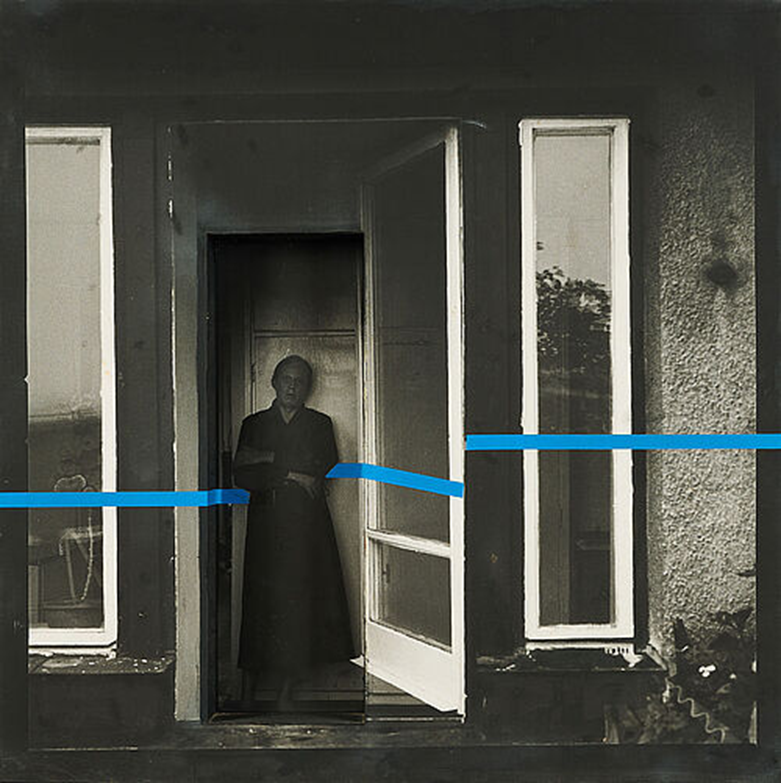
What makes Krasinski's works so exciting today and why is his object attracting increasing interest on on the international art market? One important aspect is the consistent exploration of space and the use of minimalist design. Krasinski is particularly well known for for his striking works, which create a subtle tension in their simplicity. He often worked with simple geometric shapes, how lines and rectangles, and combining them with the architecture of his exhibition spaces.
A central element in Krasinski's works are his "blue lines" - lines that he often drew directly on walls to integrate them into the space and inviting the viewer to enter into a direct dialog with the surroundings. The height of the adhesive tape is always 1.3 m. Through the simple gesture of drawing a line in the space, he created a kind of interface between art and and the real world. He combined this technique with the concept of "space as image", in which the boundaries between the artwork and and its surroundings became increasingly blurred. The minimalism in Krasinski's works acts not as an isolated reduction, but rather as a means of creating an open, interpretative relationship between art and the viewer.
Influence on the Polish art scene and the importance of a "Polish soul"
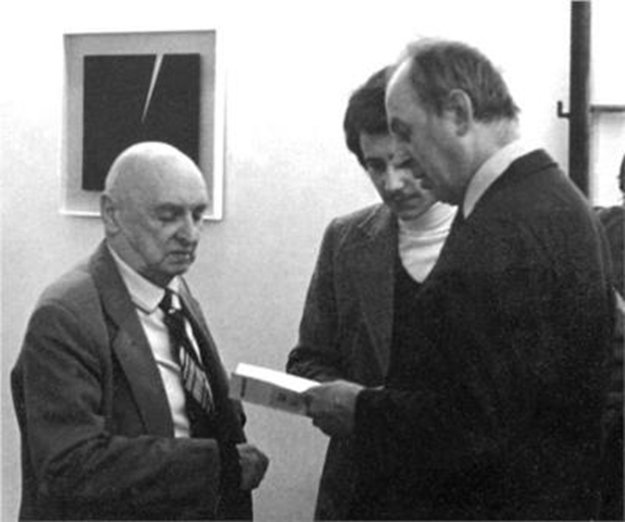
Edward Krasinski was born in 1925 in Luzk, now Ukraine. From 1940 to 1942, he studied interior design and graphic design at the Cracow School of Arts and Crafts. After the Second World War, he studied from 1945 to 1950 at the Academy for of Fine Arts in Krakow in the studio of Prof. Wadysaw Jarocki and Eugeniusz Eibisch. As a representative of Polish modernism, he experienced the effects of communism and and Soviet influence on on post-war Poland. Edward Krasinski established himself not not only as artist, but also as an active player in the Polish art scene. He began exhibiting in 1962, initially working with artists from the Krzywe Koło Gallery. From 1966, he co-founded the Foksal Gallery, where he repeatedly presented his works works.
Krasinski's influence on on the Polish art scene should be not underestimated. In particular, he shaped the development of conceptual art and of minimalist trends in Poland and and contributed to that their growing importance in the late 1960s and 1970s. Krasinski's innovative approach opened up new ways of thinking about art, particularly with regard to on the relationship between the artwork and space and interactivity with the viewer.
Krasinski's works have been shown in numerous exhibitions in Polish and international galleries. Among others, in 2003 at the Anton Kern Gallery in New York. In 2017, the Stedelijk Museum in Amsterdam presented the artist's first retrospective in the Netherlands.
In the discussion about the "Polish soul" in art, reference is often on made to the country's deep-rooted history and and the cultural peculiarities associated with it. Polish art has in many ways expressed the country's difficult historical experiences, be it it through the effects of wars, political repression or social upheaval.

Conclusion: Why Krasinski is relevant again today
His works are of great importance in the context of today's global art scene, as they raise questions about the relationship between artwork and space, the perception of art and the possibilities of interaction with the viewer. Krasinski places the viewer not in a passive role, but challenges him to actively engage with his environment and and his lived experiences.
Moreover, Krasinski represents a central current within Polish art history, offering a subtle but defining alternative to the politically and historically charged representations found in many other works of Polish modernism. In this sense, Krasinski not is not only an important Polish artist, but also a globally recognized example for of the power of reduction and the potential of conceptual art to create new meanings in any space.
We are delighted to announce that that we have once again been able to secure a object by the Polish artist Edward Krasinski for our for our next room auction on 7 December 2024. This means that we will once again be able to present a highlight by the Polish artist.
Already our this year's spring auction on 25. Mai 2024 offered numerous top pieces of modern and contemporary art and we were able to prove once again that that we are the top address in Deutschland are the top address if it when it comes to bringing well-known Polish artist, how Zdzisław Beksiński, Wojciech Fangor and and Edward Krasiński, on to the international auction market at top prices auction!
Click here to see our current lot:
We are delighted to once again be able to offer a painting by Edward Krasinski in our oeuvre. We cordially invite you to view the painting in our exhibition rooms.
Upcoming auctions
- Interior | Antiques & Design: 6. December 2024 - 17:00 watch
- Jewelry, diamonds & luxury watches: 7. December 2024 - 13.00 watch
- Old Art, Modern & Contemporary Art: 7. December 2024 - 16.30 watch
Auction location
Bredeneyer Street 119-121 | 45133 Essen
Previews
The previews for the Auction take place in our offices - Friedrichstr. 67-67a - 45468 Mülheim and Bredeneyer Straße 119-121 - 45133 Essen .
30. November from 11:00 to 16:00 watch
01. December from 12:00 to 16:00 watch
02. December from 12:00 to 18:00 watch
03. December from 12:00 to 18:00 watch
04. December from 12:00 to 18:00 watch
05. December from 11:00 to 15:00 watch
You can find the complete catalog with all lots and further detailed information here:
Old Art, Modern & Contemporary Art
Related posts to Edward Krasinski
World record for Edward Krasiński
Interesting links:
Edward Krasiński - Display at Tate Modern | Tate
You would like to consign art?
If also you want your works of art, watches, jewelry from our house estimate, so simply contact us, our experts advise you gladly, free and without obligation.
- Phone: +49 (0)208 - 305 90 81
- E-mail: info@wettmann.com
- WhatsApp: +49 (0)1520 - 493 58 35
- All other information about Consign & auction

